
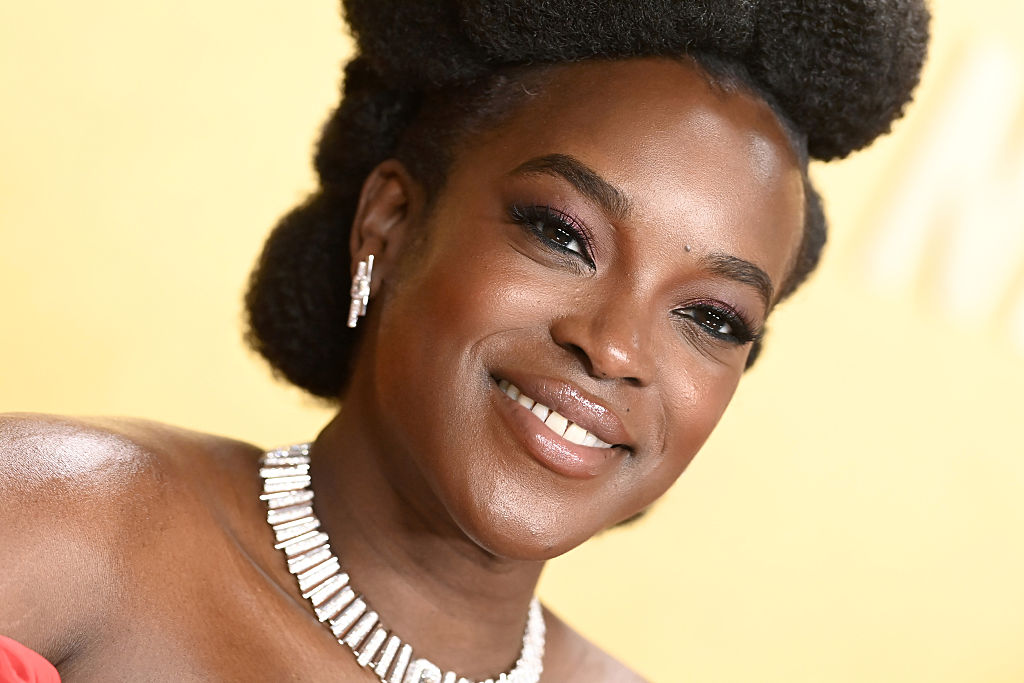
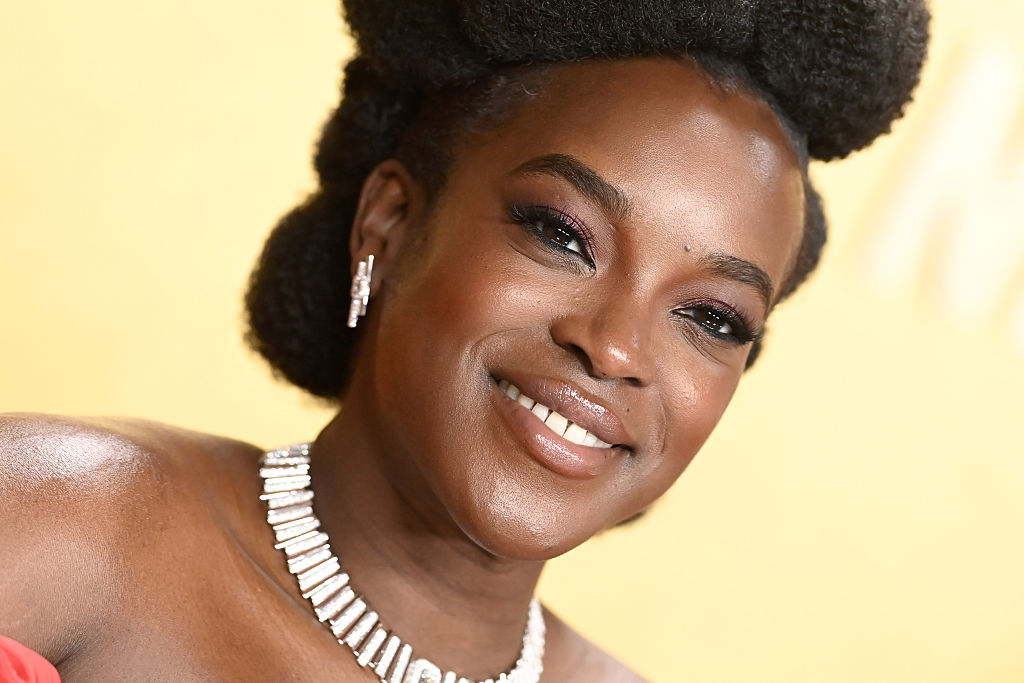
 Source: Axelle/Bauer-Griffin / Getty
When readers opened the latest edition of the New Yorker and saw the illustrated portrait accompanying its profile of Wunmi Mosaku, many had the same immediate reaction: Who is that supposed to be?
The drawing, rendered in the magazine’s familiar editorial illustration style, shows Mosaku standing stiffly in front of shelves of apothecary jars. She wears a loose blue jacket over a plain shirt. The clothing is shapeless, and her posture is rigid. Her expression is muted. Her features are flattened almost to the point of anonymity.
Without the caption, most readers would never know that the woman in the illustration is a BAFTA-winning actress whose beauty and presence command the screen.
Love NewsOne? Get more! Join the NewsOne Newsletter
We care about your data. See our privacy policy.
Placed beside actual photographs of Mosaku, the contrast is startling. Because the real Wunmi Mosaku looks nothing like that. Nothing like that! Mosaku is striking. She has luminous skin and sculpted cheekbones. Her deep, expressive eyes hold the camera with a quiet intensity. On red carpets, she is glamorous and statuesque. In photographs, she is magnetic. In motion, she carries a sensual authority that is impossible to ignore.
In Sinners, the film that has catapulted her into global conversation, Mosaku plays a hoodoo healer whose mystique and sexuality anchor the story’s emotional pulse. Her scenes with Michael B. Jordan crackle with tension and intimacy. The character she embodies is powerful, alluring, and unforgettable.
Yet the illustration accompanying her New Yorker profile strips all of that away. It does not exaggerate her beauty the way editorial art often does for celebrities. It does something stranger. It erases it.
Within hours of the issue circulating, fans, cultural commentators, and entertainment blogs began dragging the illustration for what they said was a startling failure to capture Mosaku’s likeness. One widely shared reaction summed up the mood bluntly: “Harpo, who dis woman?” For those who don’t know, this is a riff on the famous line from The Color Purple, used online to express disbelief at how little the drawing resembled the actress.
On platforms like X, Threads, and Reddit, the same criticism appeared again and again: the portrait looked nothing like her. Many viewers said they would never have recognized the BAFTA-winning actress if her name hadn’t been printed above the illustration. Others described the image as stiff, flattened, and strangely generic compared with the striking photographs of Mosaku circulating from the red carpet and press tours for the film Sinners.
Some reactions were even harsher. Critics online called the image “disrespectful,” “disappointing,” and even “anti-Black,” arguing that the illustration drained Mosaku of the beauty, charisma, and presence that define her public image.
The backlash became loud enough that another artist stepped in to show what many viewers felt the original drawing should have done in the first place. Black illustrator DeAnn Wiley posted a quick redraw of Mosaku in a similar editorial style, saying she wanted to depict the actress “with intention” and with “a love of Black women.” The alternative portrait spread quickly online, with many commenters saying it captured Mosaku’s likeness far more effectively than the magazine’s version.
The controversy has also spilled into discussion forums and entertainment spaces, where users have debated whether the problem lies in the illustration style itself or in a broader lack of care in depicting Black women in editorial art. On one Reddit thread discussing the issue, commenters shared Wiley’s redraw as an example of how the same stylized approach could still reflect Mosaku’s actual features and presence.
Now, we need to move beyond aesthetics to power. We must ask what it means when powerful media institutions repeatedly produce moments that diminish Black people and then explain them away as oversight. We need to interrogate the editorial culture behind these moments. This artist’s depiction would be puzzling under any circumstances. But the timing of its publication makes it land harder.
Just weeks ago, Mosaku experienced what should have been a triumphant career moment. At the BAFTA Awards, she won one of the industry’s highest honors for her performance in Sinners. Instead of a clean celebration, the moment was contaminated by a shocking disruption when a white man with Tourette’s shouted the N-word during the ceremony. He also hurled the slur at her. The slur echoed through the broadcast and sparked outrage across social media and entertainment news.
When a Black actress who has just endured a public moment like that is then depicted by one of America’s most prestigious magazines in a way that barely resembles her, readers do not see the image as neutral artistic interpretation.
They see a pattern.
Now, folks might claim that the illustrator didn’t sit down and intentionally try to insult Mosaku with his drawing pen. Yes, illustration styles vary widely, and the New Yorker has long relied on stylized portraits rather than photographic realism. But style does not excuse erasure.
Editorial illustrations are supposed to capture the spirit of their subjects, even when they exaggerate or simplify certain features. A stylized portrait still recognizes the individuality of the person it depicts. Here, our eyes are not lying to us. Mosaku’s individuality disappears. And when the subject is a Black woman, that disappearance carries history.
For centuries, caricature has been used to diminish Black folks, to flatten our features, distort our presence, and reduce us to something less than fully human. Even when modern artists are not consciously participating in that tradition, its echoes remain embedded in visual culture. Which is why so many viewers looked at this illustration and felt an immediate discomfort they may have struggled to name.
The drawing is not just an artistic misfire. It shrinks her, turning her into someone ordinary and forgettable. In a moment when her brilliance should be amplified, the magazine took a powerful Black actress and made her smaller, flatter, easier to dismiss, echoing the same impulse behind the N-word that was hurled at her co-stars Michael B. Jordan and Delroy Lindo from the BAFTA stage. This slur was meant to diminish Black brilliance, and this illustration lands with a quieter version of the same impulse.
That interpretation may make some readers uncomfortable. But discomfort is precisely what happens when representation goes wrong. Images shape perception long before readers absorb the text surrounding them. Which raises a deeper question about editorial responsibility. An illustration like this does not appear in a major magazine by accident. Somebody commissioned it. Somebody reviewed it. Somebody approved it as the image that would represent the woman featured in the story.
Did anyone in that process pause to compare the drawing to the real Mosaku? Did anyone notice how dramatically it stripped away the very qualities that make her such a compelling figure? Because if they had, they might have realized that the portrait was not simply stylized. It was simply unrecognizable.
Because editorial choices matter.
After the BAFTA ceremony, the BBC explained that the racial slur remained audible in the replay of the broadcast because the editors simply “didn’t hear it” in time to remove it. In other words, a racial insult aimed at Black actors slipped through the editorial process of one of the world’s most powerful media institutions.
Now here we are again, looking at another editorial decision, this time from one of America’s most prestigious magazines, where the final product leaves many Black viewers asking the same question: How did nobody catch this?
Because for a lot of Black viewers and readers, these moments do not feel isolated. They feel cumulative, and yes, intentional. And when Black audiences raise an eyebrow, we are told again and again that we are imagining things. We are told that it’s just a stylistic choice, just an oversight, nothing to see here. But after a while, the pattern begins to look less like coincidence and more like a familiar ritual where the insult arrives, and the denial and claims of innocence arrive right behind it.
First, the slur echoes across the BAFTA stage and ends up preserved in the broadcast. Then a major magazine publishes a portrait of a stunning Black actress that barely resembles her. In both cases, the explanation comes down to editorial oversight. Someone didn’t hear it, someone didn’t see it, someone didn’t notice.
But from the outside, the pattern lands differently. It feels like Black audiences are expected to absorb the insult, whether it arrives through a microphone or through ink.
And that is why the reaction to this illustration has been so strong. Not simply because the drawing misses Wunmi Mosaku’s likeness, but because it arrives in a moment when Black viewers are already asking why major media institutions keep letting moments of disrespect slip through their editorial filters.
Black folks are often told that we’re imagining things. That we’re being overly sensitive. That what we see and hear isn’t really there. But Black people have spent generations learning how to recognize disrespect even when it arrives disguised as something else, whether it is an editorial oversight, a stylistic choice, or an ‘honest mistake.’
We know what our eyes see. We know what our ears hear. So the question isn’t whether these institutions noticed. The question is this: How many ways do powerful institutions think they can call us the N-word?
SEE ALSO:
Tourette’s Tic Blamed For The N-Word Yelled During BAFTAs
Why Black People Don’t Have To Accept The Apology Or The Gaslighting