
:max_bytes(150000):strip_icc():format(jpeg)/julia-lyubova-110425-5-c4aa7b93a51c4a278948dc75b787c5dc.jpg)
NEED TO KNOW
- Julia Lyubova has 10 years of mountaineering experience, but summiting Mount Everest proved to be a challenge unlike any other
- On her ascent, the Alpine expert, 44, started to experience cold symptoms; as she climbed down, her sore throat became something worth an emergency helicopter rescue
- Lyubova documented her climb up the world’s tallest mountain on her Instagram page, where she regularly shares mountain content for over 55,000 followers
Julia Lyubova admits that she went to Mount Everest with the “wrong mentality,” but on the other side of the climb, she was all too aware of how much it takes to summit the world’s highest mountain.
“I think I underestimated the mountain in terms of how big it is,” the mountaineer, 44, tells PEOPLE months after her two-month-long journey this past spring. “I was thinking of Everest as an easy peak. When I spoke to my Sherpa guides and my friends in Nepal about Everest and how difficult it is, they said, ‘Oh, it’s fine. For you, it’s no problem.'”
And with 10 years of climbing experience behind her, Lyubova believed those who said she might not suffer too severely on the 29,032-foot ascent. She’d previously summited many other intense peaks, like the Matterhorn, Mount Kilimanjaro and smaller Himalayan mountains, like Ama Dablam and Manaslu, but Everest presented a set of circumstances that would rattle any climber, no matter their level of experience.
Julia Lyubova
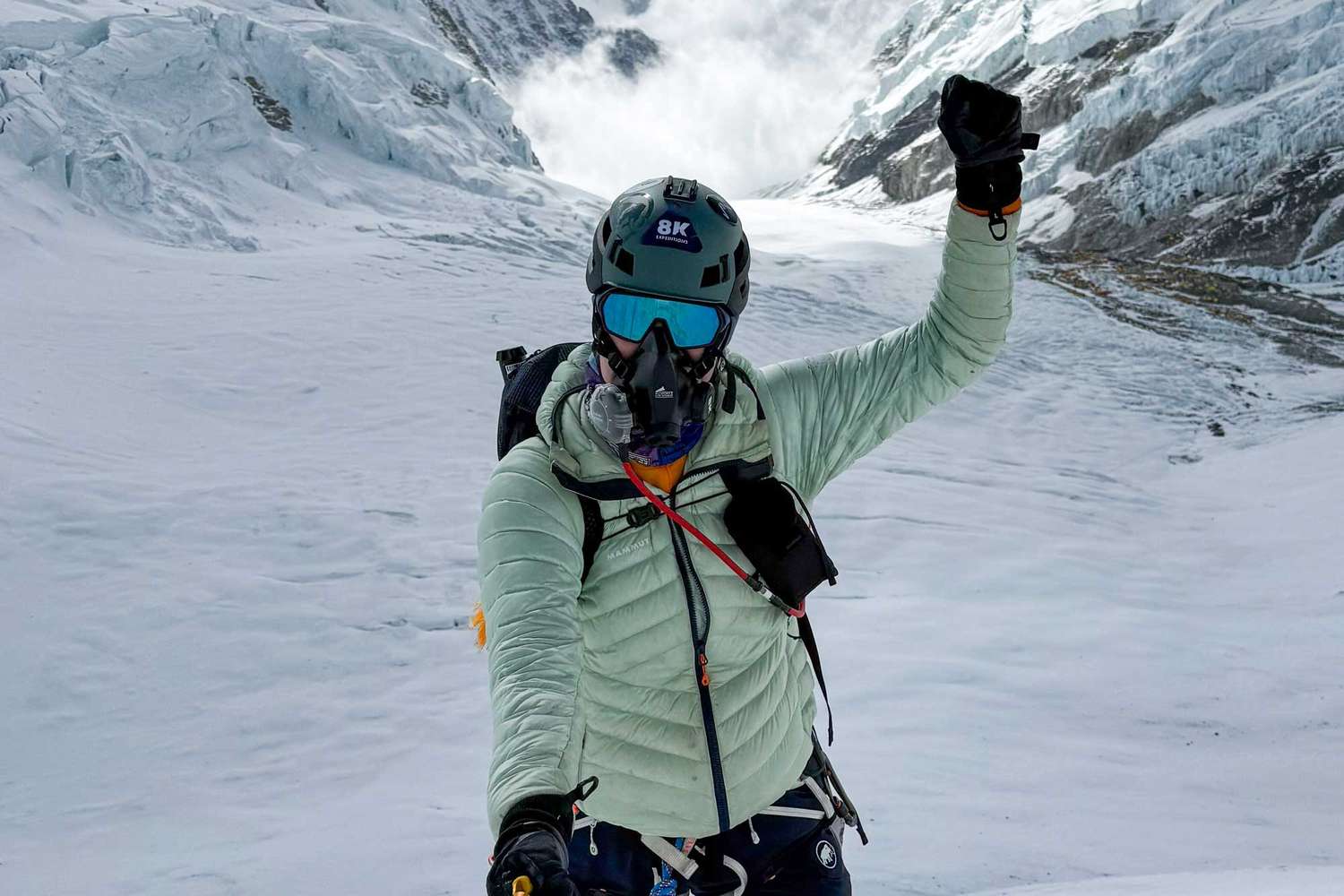
She felt it first on her summit day, after acclimatizing and readying herself for the climb up from base camp. Lyubova felt a tickle in her throat upon arrival at Camp 2. At an elevation of about 21,000 feet, she assumed it was just “Khumbu cough,” as climbers call the respiratory irritation caused by the high, dry air.
At the time, she assumed the symptoms were creeping up on everyone climbing alongside her. She figured that was just her body’s natural and normal reaction to altitude. Then, between Camps 2 and 3, her energy tanked.
“Even my guide said to me, ‘Julia, what’s wrong with you? You are normally a strong climber, why are you moving so slow?’ I didn’t know what it was,” recalls Lyubova, who chronicles her Alpinist journeys for over 55,000 followers on Instagram.
“I had the power to go, but I was just feeling rather slow,” she adds. “I wanted to take breaks much more frequently. I just didn’t feel right.”
Somehow, she still managed to push up to Camp 4, digging deep to find the will to push on and slowly pushing along. She was far more affected by the altitude than on any other mountain she had climbed before.
On the day she was expected to make the final ascending climb from Camp 4 to the top of Everest, she started to question what it was all for. If putting one foot in front of the other was such a struggle, why was she doing it at all?
“What is the point of putting myself through all this pain and through all this suffering? Do I not love myself enough? All these things were going through my head,” says Lyubova.
“I wanted to turn around several times, but then I couldn’t really allow that thought in my head because if I allowed it, then I would not find the strength to continue to the summit,” she admits. “I really had to fight with myself to make sure that I didn’t give up. It was really hard to just keep pushing, to just keep finding the reasons to keep going.”
Julia Lyubova
A force inside her moved her legs, and it moved her arms. She didn’t know where it was coming from, but it was bringing her closer to the summit. Eventually, she propelled herself far enough to see the summit. She guesses that the remaining climb would’ve taken her about five minutes if she were dealing with her typical energy levels; instead, it took her 30 minutes to get up to the top. It felt like forever.
Lyubova says she felt a mix of emotions at the summit, though most notably she was relieved — because her ascending hike was over — and exhausted. She wanted to sit down and take it all in, to have that moment of “Wow, I am on top of the world.” She adds, “It’s really hard to sink in there. It didn’t sink in until maybe a week or something later.”
Her focus shifted to the descent, which was suddenly the “hardest part,” says the mountaineer. “Imagine: I got up there, I had no power left, and I still have to go all the way down.”
Never miss a story — sign up for PEOPLE’s free daily newsletter to stay up-to-date on the best of what PEOPLE has to offer, from celebrity news to compelling human interest stories.
It typically takes two days to return to base camp, depending on where one plans to rest. Initially, Lyubova was hoping to make it all the way down to Camp 2 on her first day of descent, because she wouldn’t need to sleep with an oxygen mask on.
“I felt really uncomfortable with sleeping with oxygen, I kept on waking up to check it’s working,” she explains. She slowly moved down the mountain, arriving at Camp 4 around 4 p.m. Her guide suggested stopping there, but Lyubova wanted to inhale and exhale with ease. She guessed that the more she descended, the better she would feel.
However, as the air became breathable, that tickle in her throat progressed. She started to cough, and hacking was turning up green, bloody phlegm. Lyubova sensed she had an infection of some kind, and on the way down from Camp 4, she was suddenly unable to breathe at all.
“I fell to my knees. I was like, ‘Help,’ to my guide, ‘Lakpa, help me help me,'” she says. “He put my oxygen onto the emergency level four.”
Julia Lyubova
Her breathing returned to functionality, and her sense of urgency heightened. She wanted to get down the mountain. On her way out of Camp 4, Lyubova was stopped in her tracks. She saw a dead body, and she thought she recognized them.
“It was a different person, but at the time, I didn’t know the full story. I thought it was the climber that I saw that morning descending, and now I saw him in a kind of sleeping position outside of Camp 4,” she recalls. “I thought he died that day. I’ve never been so scared for my life. I thought, ‘I’m going to die next.'”
“I was exhausted. I was sick. I had literally nothing,” she adds. Lyubova could only cling to her belief that better health awaited her at the lower camps.
“When we got to Camp 2, I was very weak. I was just walking like a zombie, if you can imagine how slowly I was moving,” the Switzerland resident shares. After what happened at Camp 4, she was afraid to sleep, and her lungs started to make a sound that startled a guide on her climbing team.
He guessed she had high-altitude pulmonary edema (HAPE), a potentially fatal mountain sickness that causes a buildup of fluid in the lungs, per Cleveland Clinic. Soon, she was gasping for air again, and she was advised that the safest route down was a rescue air lift from Camp 2.
Julia Lyubova
“I never had these problems before in my life with altitude … I didn’t want, I was very annoyed at that. But what can you do? Your body’s just decided that that’s how it is,” Lyubova explains. A helicopter brought her down to Base Camp, where she still needed oxygen to help her breathe. She finally regained control when they reached the lower municipality of Lukla.
“Suddenly, I coughed up this huge amount of phlegm. I don’t know how it fit inside my throat, but I think what was happening is that all of this phlegm was blocking my airways,” she notes. “That’s why I couldn’t breathe and that’s why it was developing into HAPE, because obviously I was at high altitude.”
When she arrived at Kathmandu, she was immediately taken to a hospital via ambulance. They ran tests to ensure that her rapid descent didn’t turn her HAPE into anything worse. With the help of antibiotics, she managed to get the infection under control in a hotel room.
The experience served as an extreme way to learn what Everest requires of its challengers. Even setting her HAPE aside, she acknowledges the sheer emotional strain of facing mortality on the mountain.
Julia Lyubova
“On the Summit Ridge, you walk past one dead body and then a second one. The first one is actually lying right next to the path, and you can’t help but look at this person,” Lyubova tells PEOPLE. “I was prepared mentally to see that person there, but when you do in real life, it’s like, ‘Wow.’ You think, ‘That could be me.'”
Speaking relative to those fatal circumstances, Lyubova was one of the lucky ones. She remembers speaking with a “Himalayan veteran,” someone with several steep mountains of experience, and he warned her of the ways the trek leaves inevitable marks on those fortunate enough to return home after the climb.
“He told me about what they call the Everest tax, where a person will get affected in one way or another,” says Lyubova. “Nobody summits Everest or leaves Everest unaffected.”