
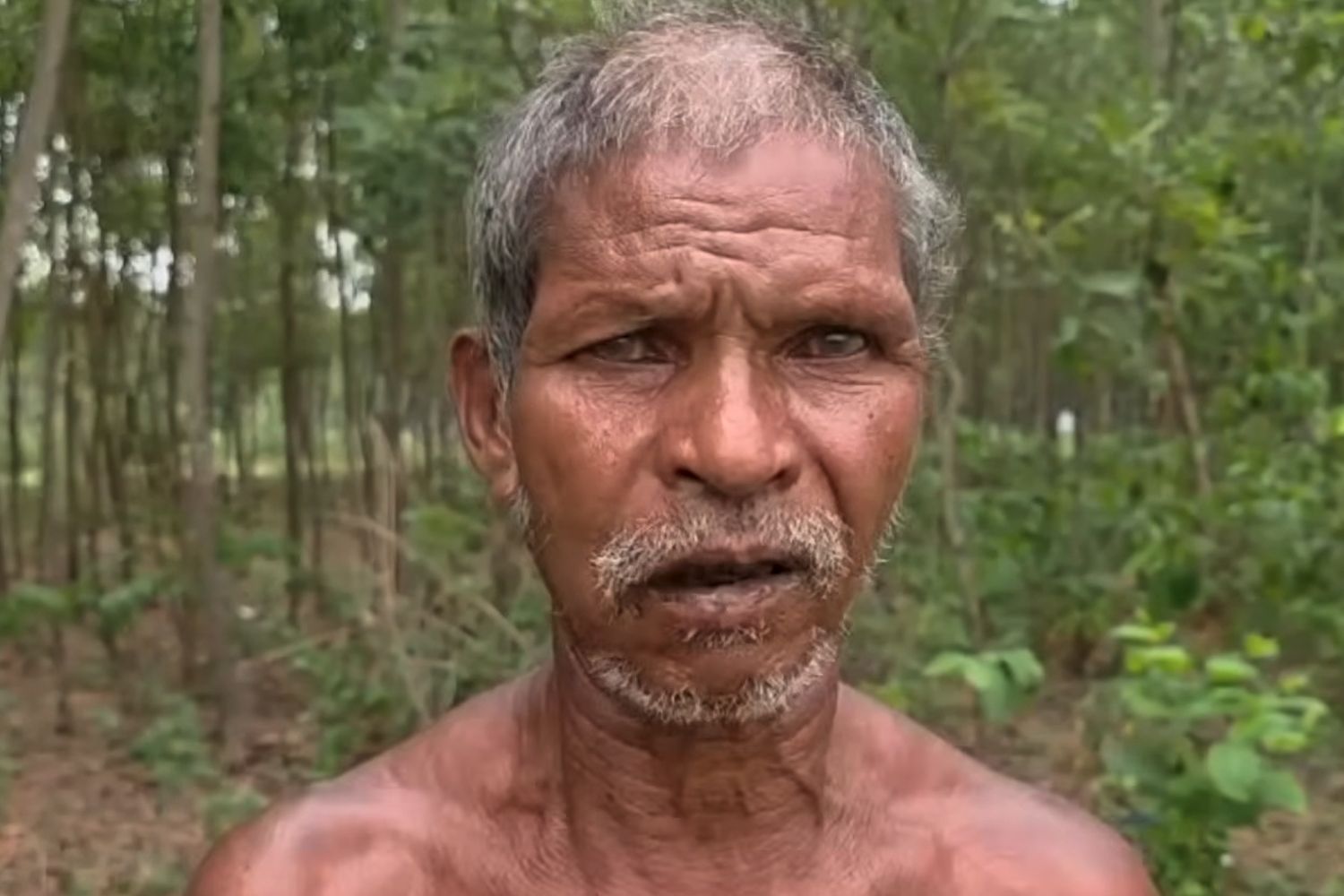
"I brought her remains to show that she was dead," said Jitu Munda, who dug up his sister's body
:max_bytes(150000):strip_icc():format(jpeg)/Jitu-Munda-042926-e4740fd50d46400b9887c537f2c90cb5.jpg "Jitu Munda")
Credit: BBC News Hindi/YouTube
NEED TO KNOW
- A 52-year-old man brought his sister’s exhumed remains to a bank in eastern India to claim the money she left behind
- The tribal man did not have a death certificate and felt like he had no other way to recoup the funds, according to reports
- The Indian Overseas Bank pushed back on allegations surrounding the incident, which was caught on video, and said the woman’s heirs have since received the money
Warning: Readers may find some of the details and video footage in the story disturbing.
A 52-year-old man dug up his sister’s body and carried her remains to a bank in eastern India. The man, who was unable to provide a death certificate, wanted to prove that she died to claim the funds she’d left behind.
A video went viral this week that showed Jitu Munda, who hails from a tribal community in the state of Odisha, carrying his sister’s body to a local branch of Indian Overseas Bank, CBS News, the BBC and The Times of India reported. He dug up Kalara Munda’s remains after employees at the bank told him that he couldn’t withdraw funds without official proof of her death, such as a death certificate, according to reports.
“I was asked to prove whether my sister was alive or dead,” Munda said, according to The Times of India. “Since I had no papers, I brought her remains to show that she was dead.”
In a statement posted on social media, the Indian Overseas Bank claimed that allegations that Munda was asked by bank staffers to bring the “physical presence of the deceased for claim settlement, are incorrect and not based on facts.”
The organization said the incident occurred because of “lack of awareness of the claim settlement process” and the person’s “unwillingness” to comply with procedures explained to him by the branch manager, which included showing official documents like a death certificate.
Munda, whom the organization alleged had been in an “inebriated condition,” left and returned with his sister’s remains. “This created a highly distressing situation at the premises,” bank officials said. “Local police authorities were immediately informed, and the matter was handled under their supervision.”
As of Tuesday, April 28, government officials had issued the required death certificate and legal heir certificate, the organization said. The claim amount of 19,402 rupees (about $200 USD) was then given to the legal heirs.
The much-talked-about incident prompted criticism of both the bank and local authorities for not doing more to assist the man, the BBC reported. In India, if a bank member dies without naming a nominee, family members must present official documentation for the funds to be released, which can take an extended period of time, especially in remote areas, according to the outlet.
Suresh Pujari, the revenue minister of Odisha, told the BBC that the case is being investigated and that action would be taken against the branch manager for his alleged behavior.

Credit: Google Maps
Never miss a story — sign up for PEOPLE's free daily newsletter to stay up-to-date on the best of what PEOPLE has to offer, from celebrity news to compelling human interest stories.
Pujari’s office and the Indian Overseas Bank did not immediately respond to PEOPLE’s requests for further comment.
Local officials later spoke with Munda to encourage him to return his sister’s remains to their resting place, and he has been offered 30,000 rupees (about $316 USD) in assistance, according to the report.