
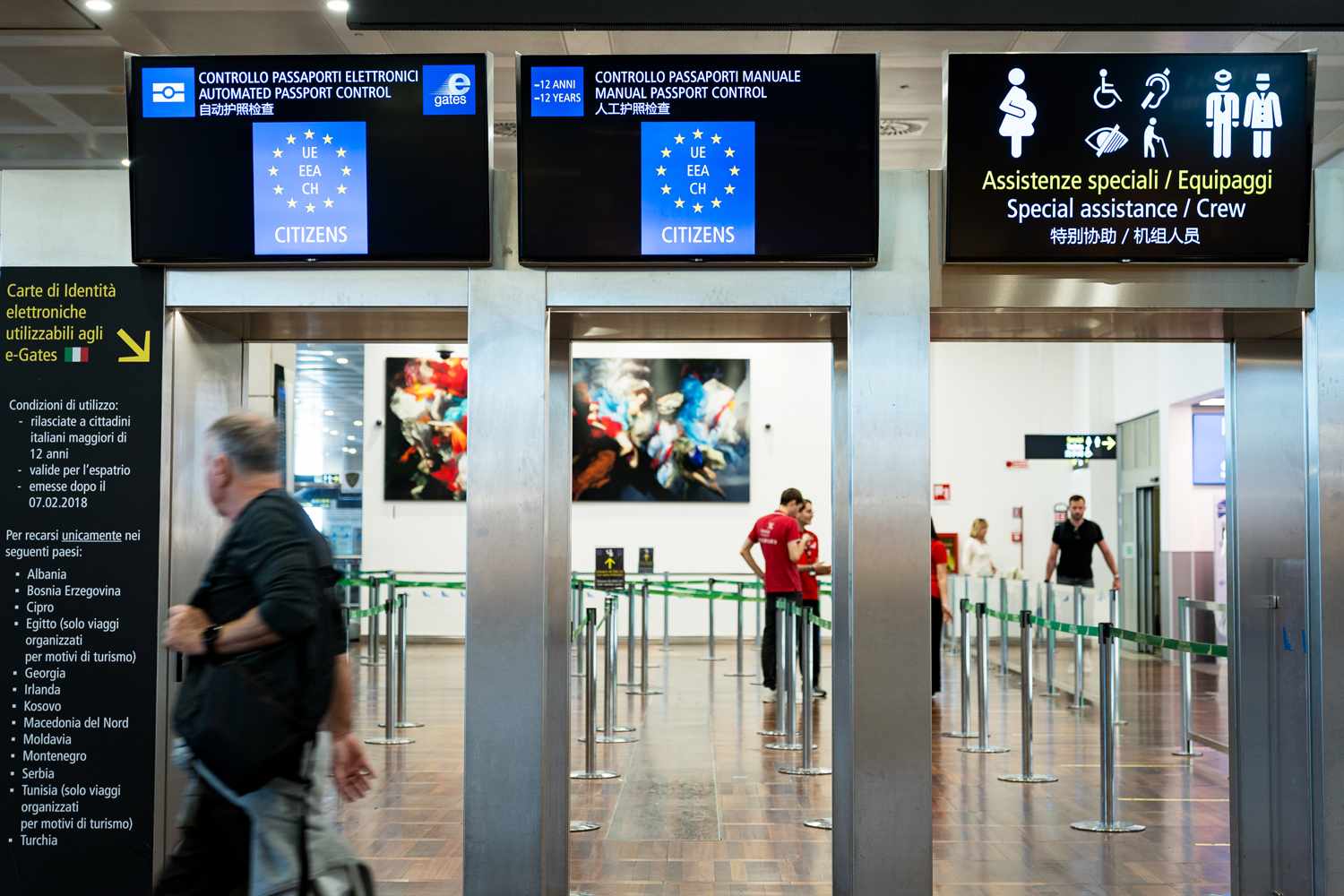
The system became fully operational across the European Union on April 10 and all non-EU citizens must use it to enter
:max_bytes(150000):strip_icc():format(jpeg)/Passport-control-international-flights-052926-0a7186a3f2fe43de9443cae594265242.jpg "Passport control for international flights is seen at Venice Airport, with digital screens displaying information about the European Union's Entry/Exit System (EES)")
NEED TO KNOW
- The EU’s Entry-Exit System (EES) replaces manual passport stamping with automated biometric data collection for non-EU travelers
- Travelers have reported long delays at airports like Lisbon, while others experienced smooth processing in cities like Barcelona
- Experts say the system struggles with large-scale implementation despite processing nearly 80 million crossings since 2025
Americans traveling to Europe are facing a Euro summer bummer as the EU's new Entry-Exit System (EES) is causing chaos at many airports.
The new program replaces manual passport stamping with an automated digital system that records biometric data (fingerprints and facial images), personal details, and exact entry and exit times for all non-EU residents entering the 29 Schengen countries of the European Union. That includes many summer travel hotspots like Spain, France, Italy, and Germany.
EES was first launched in October 2025 and became fully operational across the EU on April 10 of this year. The EU says the system will make border checks more modern and efficient, preventing "irregular migration," and increasing security.
However, as tourists flood Europe's cities for summer vacation, it's also increasing major delays and frustrations for travelers.

Credit: NICOLAS TUCAT/AFP via Getty
In a May 28 report, a European Commission spokesperson told Newsweek that the system is “fully operational across all Schengen countries and works well at almost all border crossing points.”
The spokesperson further said that since launch, EES has processed nearly 80 million crossings and more than 35,000 refusals have been issued, including around 900 individuals who were identified as security threats.
But many travelers have reported long delays as a result of the new system. Video from CNN correspondent Clarissa Ward shows snaking lines of arriving passengers waiting to be processed by the system at Lisbon Airport in Portugal.
"I stood in the longest line I have ever seen in my life (no joke)," said Ward in the video's caption.
"I saw lots of elderly people and families with small children. People who missed connections. Others who missed flights. Me included. Airport staff only let TAP (Portugal's main airline) passengers cut the line if they were seconds away from missing their flight. Everyone else? Good luck."

Credit: JUSTIN TALLIS/AFP via Getty
Travelers are taking to social media to express their frustrations.
"POV: I Experienced the EU's New EES System and it was a nightmare!" said an American woman who traveled to Barcelona, in an Instagram post.
"In total, it took us 2 hours and 7 minutes to get through the line and we quite literally made it to our gate as they were boarding our zone. The concept makes sense on paper. The execution feels like nobody accounted for actual peak-season travel volume or what this experience would actually look like for travelers on the ground."
Some commenters had a different experience with the system.
"Took me 7 mins to get through Barcelona last week. I went there expecting hell but it was brilliant. They were so organized and efficient. I was nicely surprised!" said one commenter.
"I did Amsterdam last week and it was a breeze, took less than 3 minutes," wrote another.

Credit: AP Photo/David J. Phillip
Experts say the system was not designed to be rolled out at such a large scale.
“It's a whole combination of things that go wrong when large organizations and governments try to put in place big systems,” Dr. Nick Brown, an expert on European bureaucracy, told The Independent.
“EES was never designed to be implemented at 400 airports. It was designed to be implemented at 30 or 40 big airports where the planes come in from the Gulf, from North America," Brown said. “With ambitious plans in some places, EES is working absolutely like clockwork. In others, it isn't. We hear stories of the national authorities doing the wrong thing, and in other cases, we hear of technological chaos.”